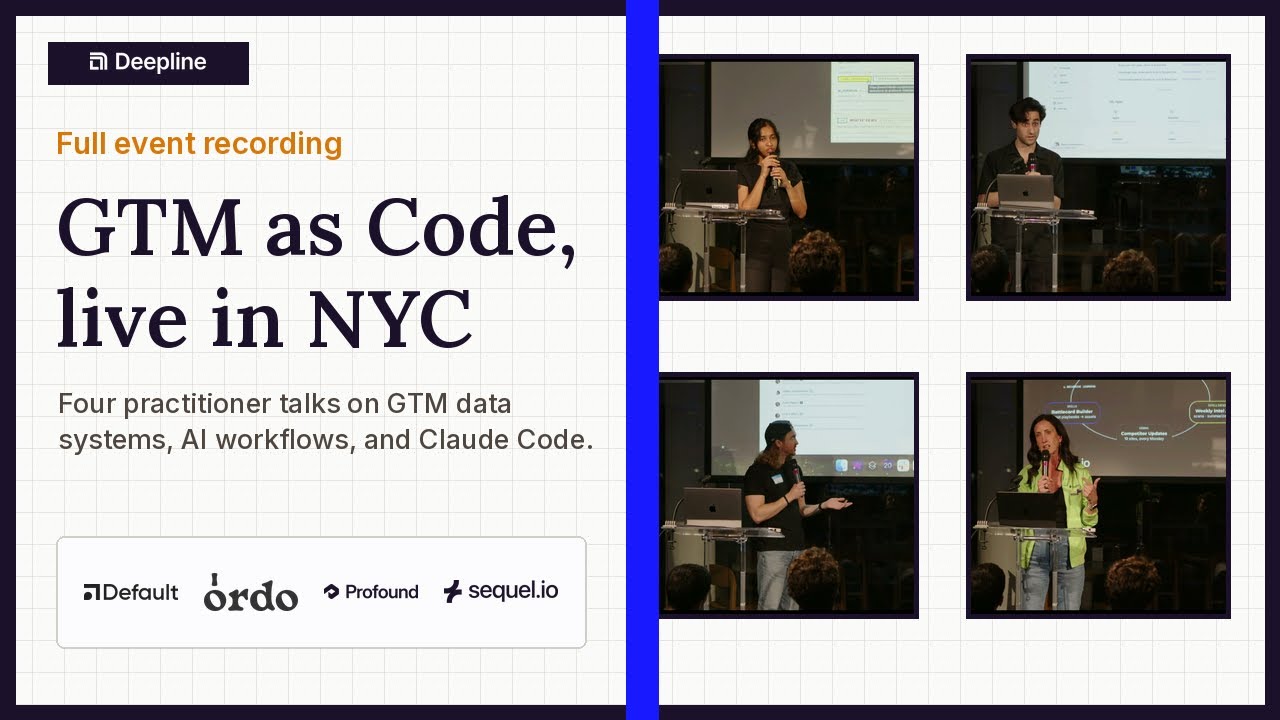
Hunter Rosenblume used school lunch procurement to show how software can help answer a request for proposal. His demo pulled out the buyer's requirements, searched the company's documents, and drafted answers for people to review.
That was one of the demos at our GTM as Code event. Other speakers showed how they decide which companies to contact and keep useful information from past marketing campaigns. Each talk below includes the recording and a short account of what the speaker built.
Full event recording
Video not loading in LinkedIn or your in-app browser? Watch it on YouTube.
Nandika Jhunjhunwala on account scoring
Video not loading in LinkedIn or your in-app browser? Watch it on YouTube.
An account can fit your target customer profile without being ready to buy. Nandika's talk explained how she separates those two questions when deciding whom to contact.
Company details, such as industry and size, help establish fit. Changes in hiring or funding can help explain the timing. She also considers web activity, product usage, interest in the product category, and the team's past contact with the account.
She uses Default to route accounts based on that information. Scores change as new data comes in. Keeping them current means remembering what has already happened and retrying work when a request fails. Her talk covered those details as well as the scoring rules.
Hunter Rosenblume on answering procurement questions
Video not loading in LinkedIn or your in-app browser? Watch it on YouTube.
A request for proposal, or RFP, asks a supplier to explain how it will meet a buyer's requirements. Answering one means finding the relevant information inside the company and checking that it addresses what the buyer asked.
Hunter's "RFP Gremlin" demo worked through that process for school lunch procurement. It extracted the requirements and searched internal documents before drafting responses. People handled the questions that needed judgment. The company could use the same stored knowledge when the next RFP arrived.
Hunter writes at hunterrosenblume.com and is building Ordo.
Partner demo: Type.com AI Teammates
Video not loading in LinkedIn or your in-app browser? Watch it on YouTube.
Type.com showed how a team could assign work to an AI agent in Slack and give it access to the tools needed for the job. They described each channel as having a shared virtual machine. In that model, people in the channel work with the same computer and the same context.
At the event, Type.com offered attendees a free two-week trial with $100 in credits. Attendees were asked to request access at type.com and mention the Deepline event.
Nick Lafferty on marketing engineering
Video not loading in LinkedIn or your in-app browser? Watch it on YouTube.
One of Nick's examples was a question a team can ask customers directly: how did you hear about us? That answer helps explain where new customers come from, a measurement problem usually called attribution.
Nick advised teams to collect data directly from its source. He described the software a marketing engineer builds to get campaigns out and measure what happens afterward.
At Profound, where he is a founding marketing engineer, Nick uses Default for routing and GitHub Actions to run automated jobs. He also uses Claude for ads and research. He writes about the work at nicklafferty.com.
Kathleen Booth on product marketing knowledge
Video not loading in LinkedIn or your in-app browser? Watch it on YouTube.
A campaign leaves behind useful material. Customer comments can change how a team describes the product. Feedback from sales can reveal a question the next launch should answer. Kathleen showed how she keeps that material available for the next campaign.
Her setup uses Claude Code with a shared collection of product marketing information. It holds the company's positioning and customer language alongside competitor notes, launch plans, and supporting evidence. Saved instructions, called skills, tell Claude how to use it. The team adds campaign results to the collection so later work can use what they learned.
She leads marketing at Sequel.io and writes at kathleen-booth.com.
Jai Toor on running GTM workflows
Video not loading in LinkedIn or your in-app browser? Watch it on YouTube.
Jai demonstrated how he finds potential customers with Deepline. He built an account list, added missing information, and showed how to decide which accounts to prioritize for outreach. He also showed how to review what the agent had done and use data from earlier runs.
He also discussed what happens when a network request fails or a tool returns an error. Someone running the workflow again needs it to handle those failures and keep the work already completed. The talk covered that repeat use alongside the demo.
More talks
Watch the June GTM as Code event in San Francisco for more talks.